Passive Compliance (Soft Robots)
Compliance built into the hardware — soft wrists, tactile sensing, and soft hands that absorb contact uncertainty before the controller ever sees it.
A controller can only react to contact after it has been measured. A compliant mechanism absorbs it immediately. This theme puts the compliance in the hardware — soft wrists, soft hands, and tactile skin — and asks what the learning problem looks like once the mechanism is doing part of the work.


Soft wrists
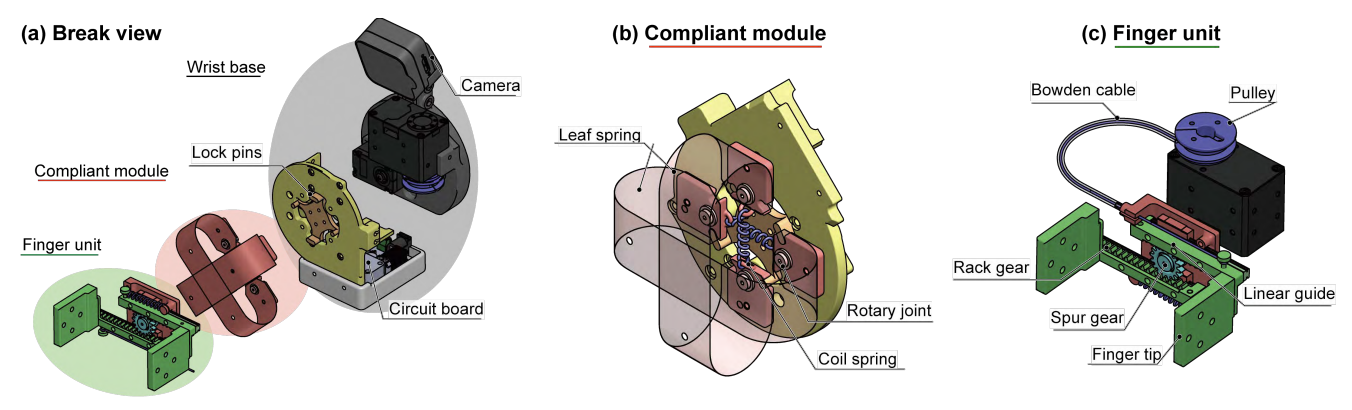
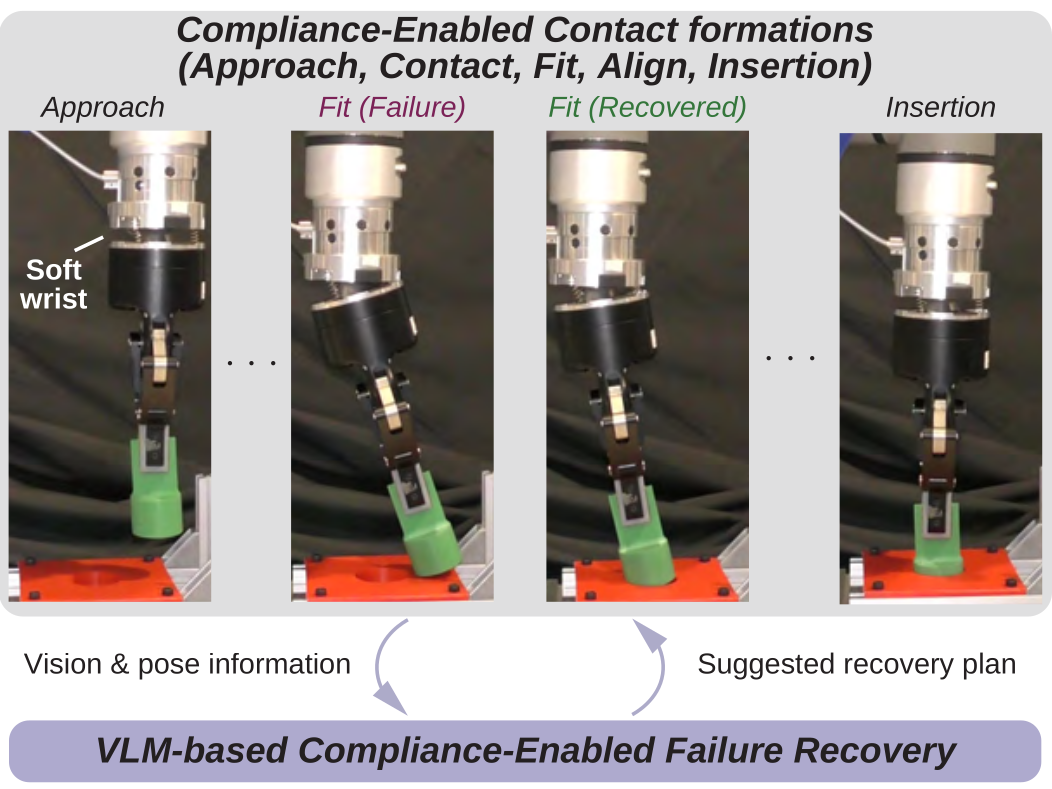
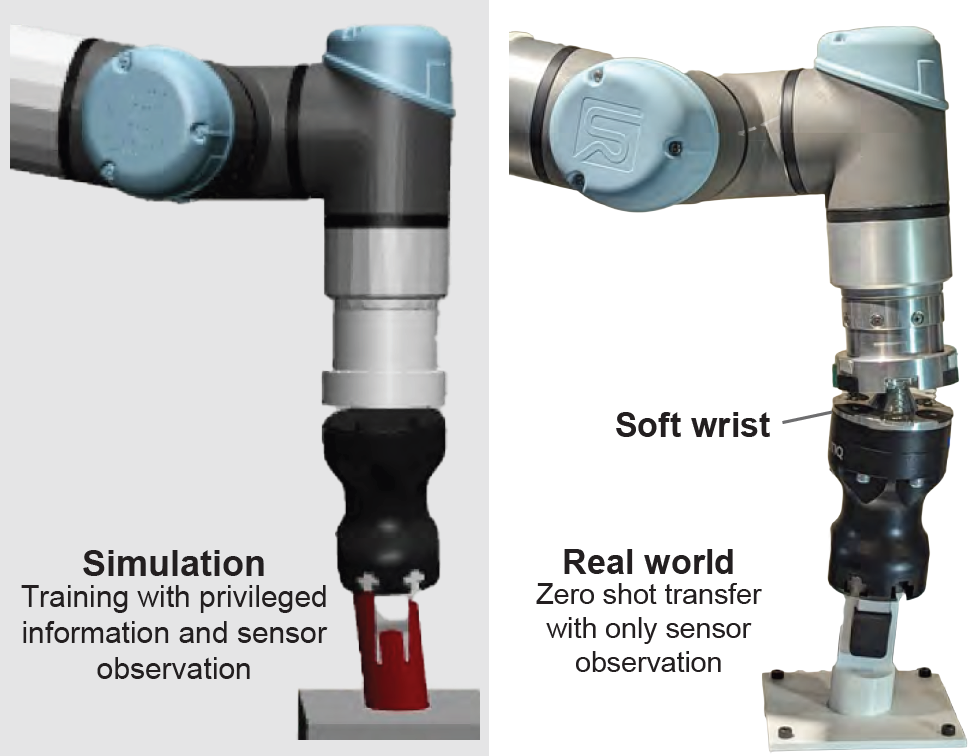
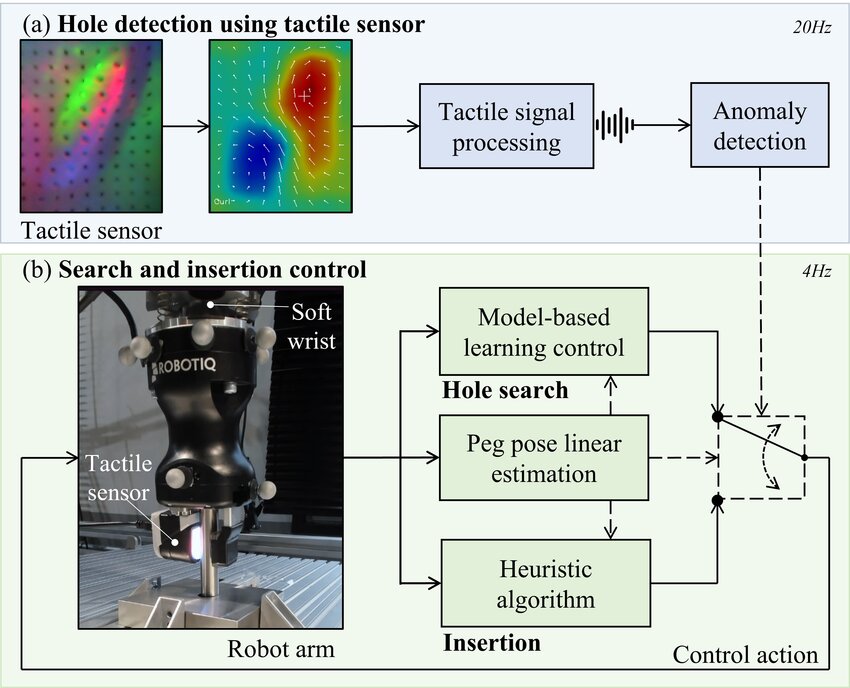
A soft wrist makes insertion forgiving, at the cost of a robot that no longer knows exactly where its own tool is — six degrees of passive deformation that no encoder reports. Sim-to-real privileged training closes that gap in two stages: a teacher policy trains in simulation with access to the true peg pose and alignment, then a student learns to infer that same information from arm pose and wrist force-torque history alone, which is all the real robot can observe (Fuchioka et al., 2024). The mechanism itself can also be designed rather than accepted as-is: a wrist with anisotropic and selectable stiffness stays compliant along the axes where contact happens and stiff along the ones where precision is needed (Oh et al., 2026). And because compliant insertion still fails, some of the work is explicitly about recovery — detecting a bad contact formation and re-establishing a good one instead of aborting (Shirasaka et al., 2026).
Tactile sensing
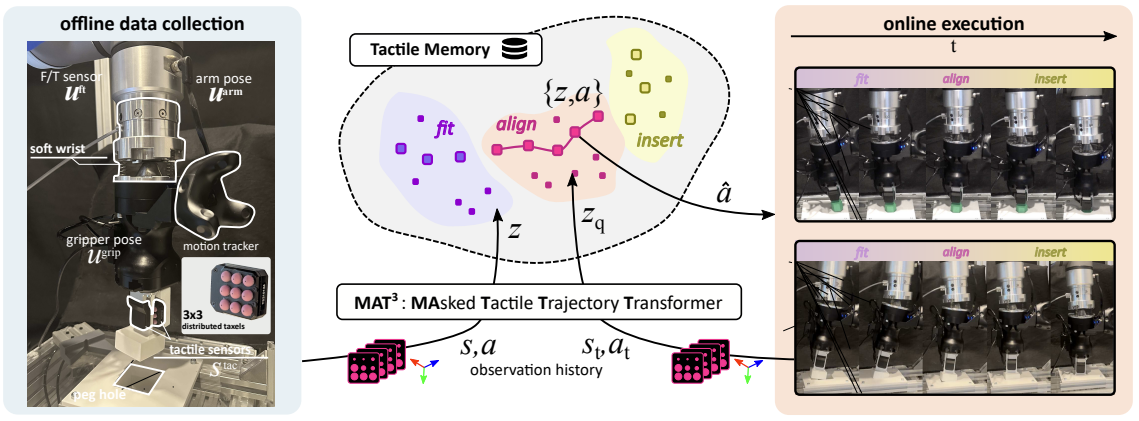
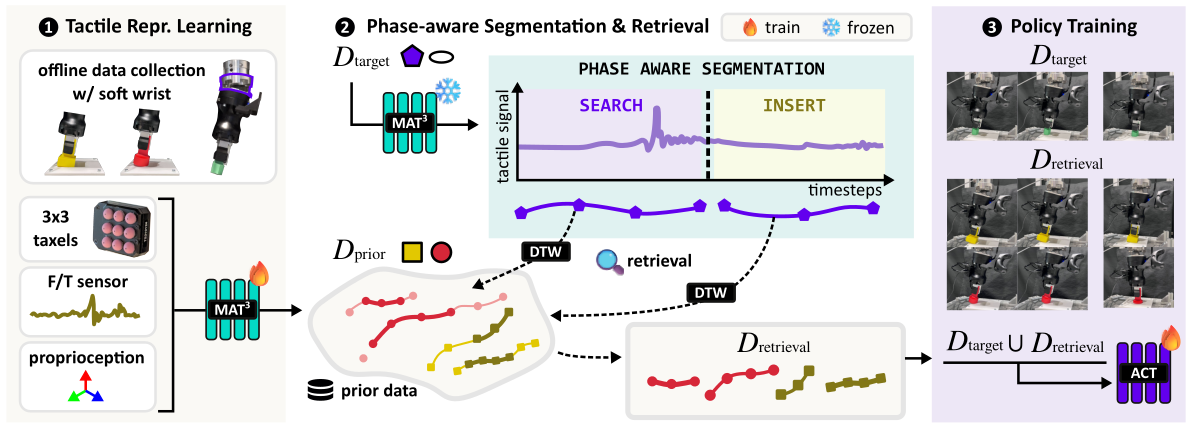
Softness and touch reinforce each other: deformation makes contact both safer and more informative. Learning robotic assembly by leveraging physical softness together with tactile sensing established the pairing (Royo-Miquel et al., 2023); tactile memory with masked encoding extends it in time, letting the robot carry what it felt a moment ago into the decision it makes now (Kamijo et al., 2026). PHASE pushes toward data efficiency, using compliance-enabled tactile phase retrieval to learn insertion from few examples (Siburian et al., 2026).
Soft hands


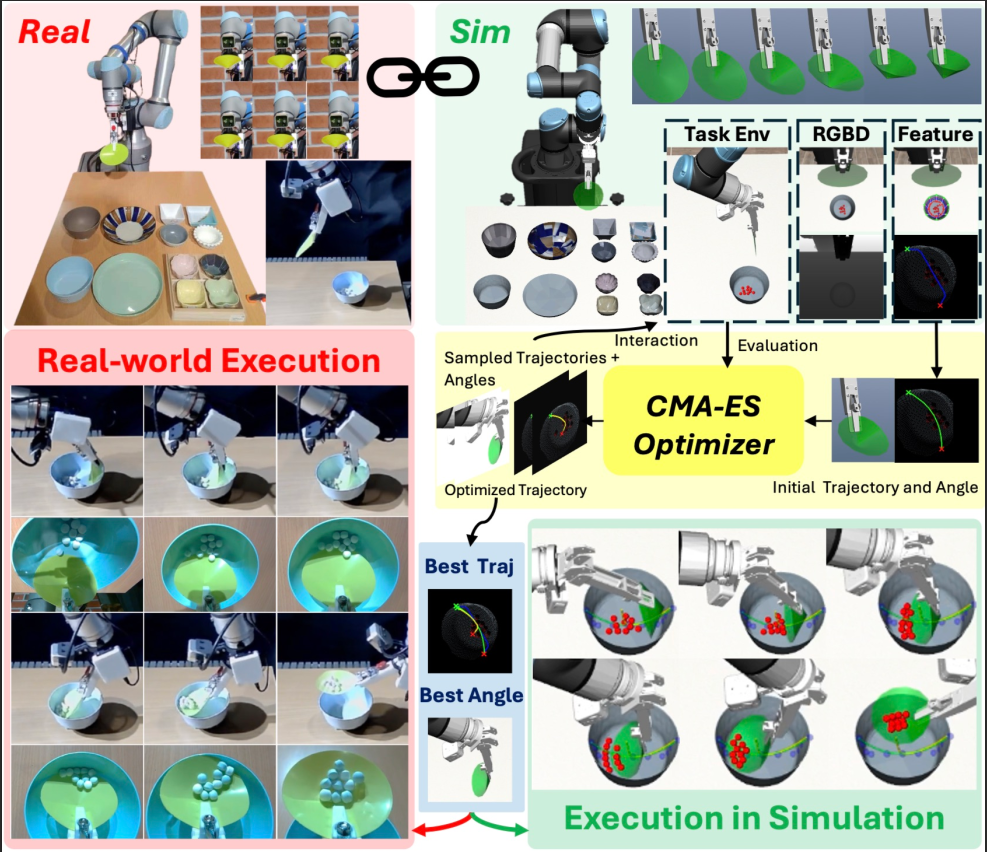
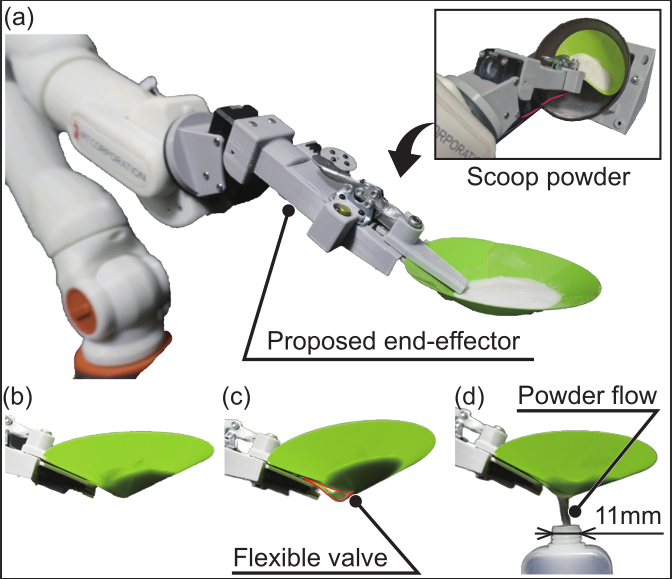
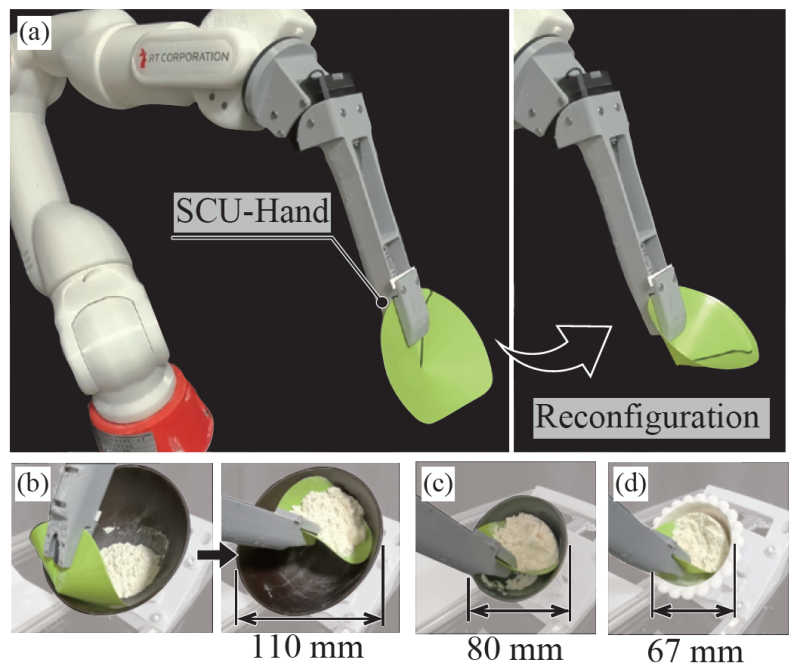
Granular media defeat rigid grippers, so the hand deforms instead: SCU-Hand is a soft conical hand that scoops from containers of varying size (Takahashi et al., 2025), with the scooping motion parameterized and optimized in simulation by an evolutionary search rather than hand-designed (Wang et al., 2026). At the other end of the scale, a flexible funnel-shaped hand with an integrated single-sheet valve handles powder at milligram resolution (Takahashi et al., 2026).
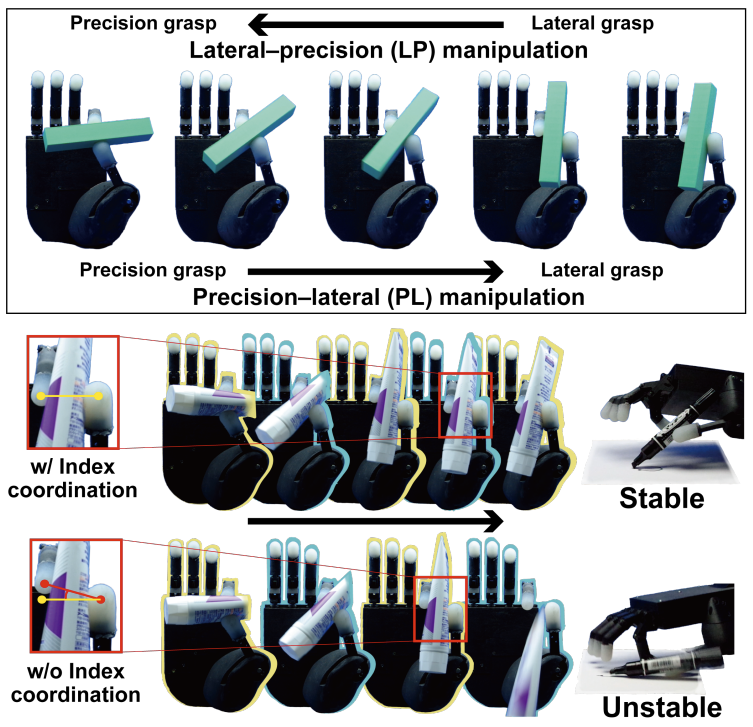
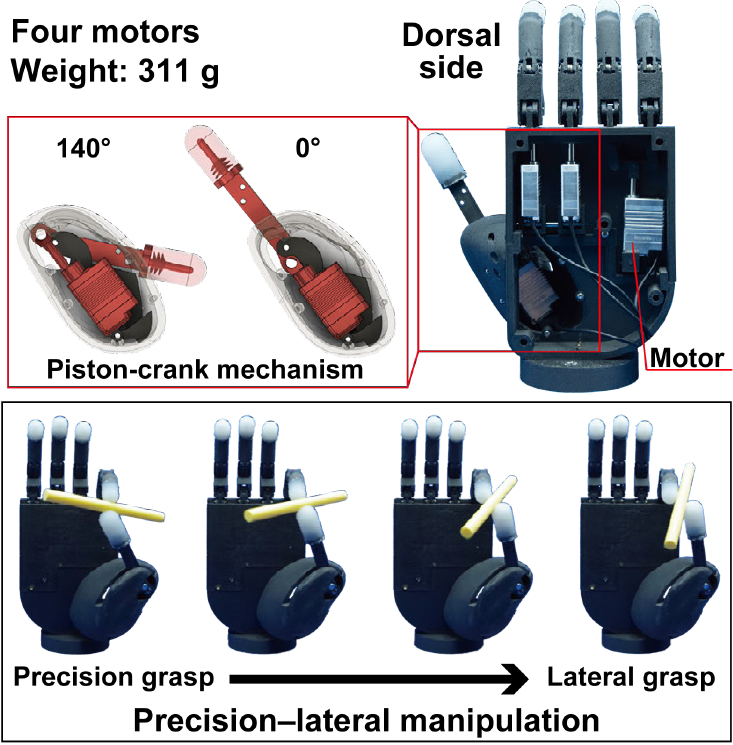
A parallel line targets prosthetics, where motor count is a hard constraint on weight: the PLEXUS hand achieves precision–lateral dexterous manipulation with four motors (Kuroda et al., 2025), and follow-up work makes that in-hand manipulation stable enough to be practical (Kuroda et al., 2026).
Lightweight mechanisms
The same principle — let the mechanism, not the controller, absorb the physics — also applies without soft materials. A five-bar linkage puts both motors at the base and moves only the links, so the arm itself weighs 19 grams. Low inertia is its own kind of safety: at that mass, contact with a human or a puck simply cannot deliver much energy, no matter what the controller does.

That mechanism became a low-cost air hockey robot for human-robot interaction research, built entirely from position-control servomotors and costing $346.8 in total (Shinjo et al., 2024). It returns the puck by intermittently adjusting its target joint positions — no torque control, no force sensing — and still achieves an average return error of 42.6 mm. Air hockey suits HRI work because players never touch each other and the state space is only two-dimensional, but the platforms used for it have typically been expensive arms requiring robotics expertise to operate. This one is meant for researchers who have neither. It was a finalist for the Best Entertainment and Amusement Paper award at IROS 2024, and there is a project page with build details.
The counterpart to all of this — compliance produced by the controller on rigid hardware — is active compliance control.