Learning contact-rich manipulation from human demonstrations — hybrid trajectory-and-force imitation, variable compliance from a few demos, and diffusion policies.
Contact-rich skills are difficult to specify as reward functions but easy to demonstrate. This theme covers learning manipulation policies from human demonstrations, with a focus on the part most imitation learning ignores: the forces.
Trajectory is not enough
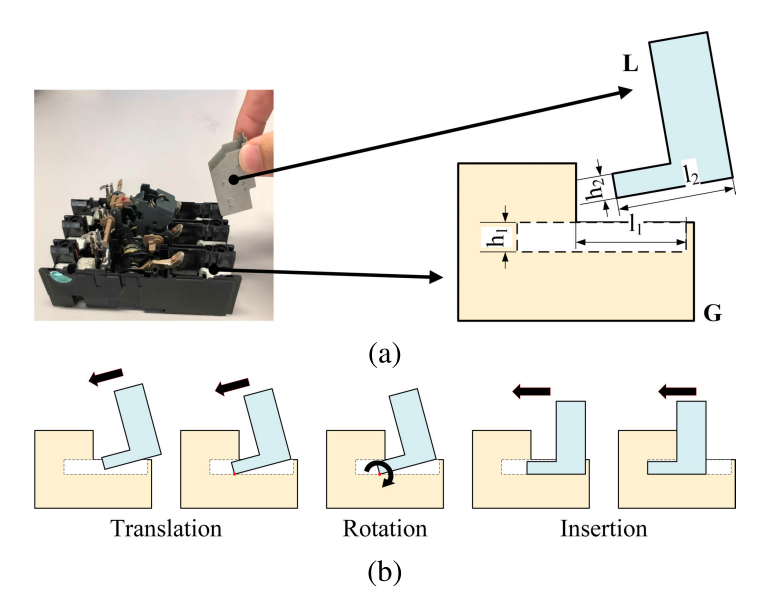
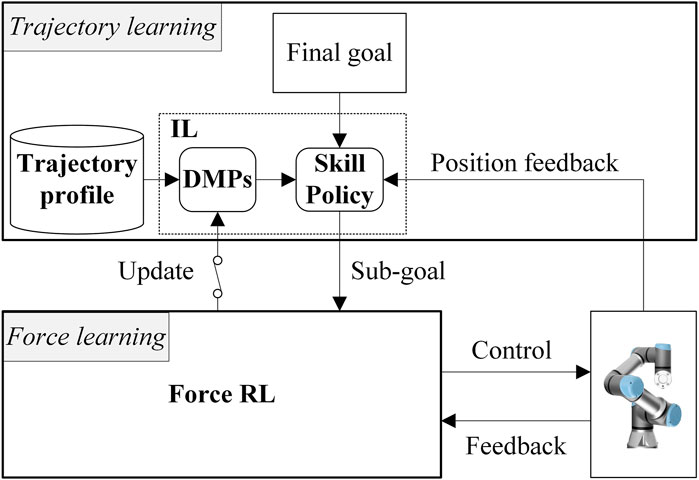
A demonstrated assembly skill is under-determined by position alone — two executions that trace the same path can differ entirely in how the parts are pressed together. Hybrid trajectory-and-force learning treats both channels as first-class, imitating human assembly skills from the recorded motion and the recorded interaction forces (Wang et al., 2021), later generalized into a combined learning framework for complex assembly (Wang et al., 2021) and an adaptive variant for insertion tasks whose contact conditions shift between attempts (Wang et al., 2021).
Learning from a handful of demonstrations
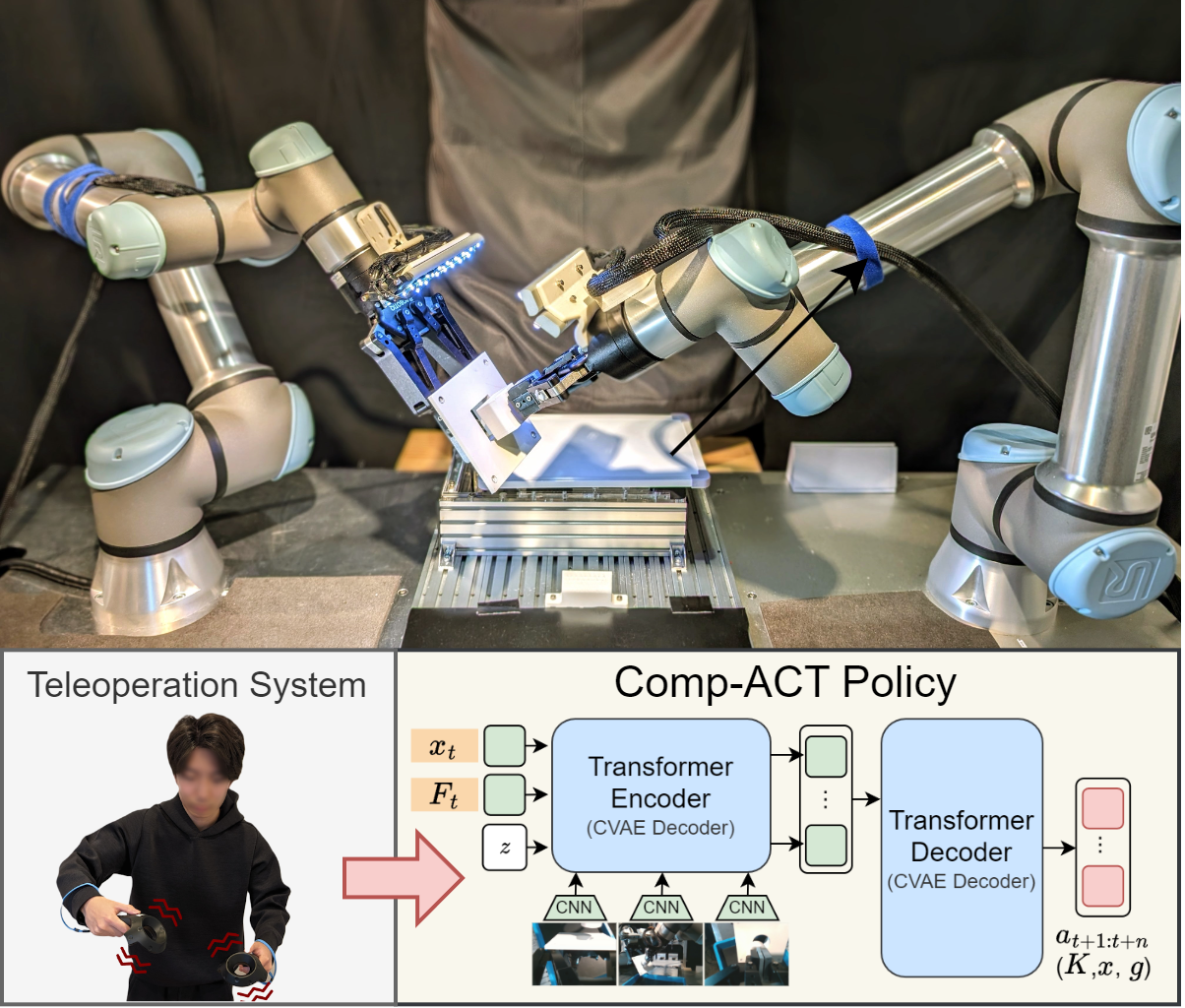
Collecting demonstrations is expensive, so sample efficiency matters more here than in most imitation settings. Comp-ACT records demonstrations through a VR-controller teleoperation interface that returns haptic feedback by vibration, so the operator’s own force regulation is captured as it happens rather than inferred afterwards. A transformer policy then learns compliance control via action chunking, predicting a chunk of future actions — stiffness included — from the current state (Beltran-Hernandez et al., 2024).
Generative and cooperative policies
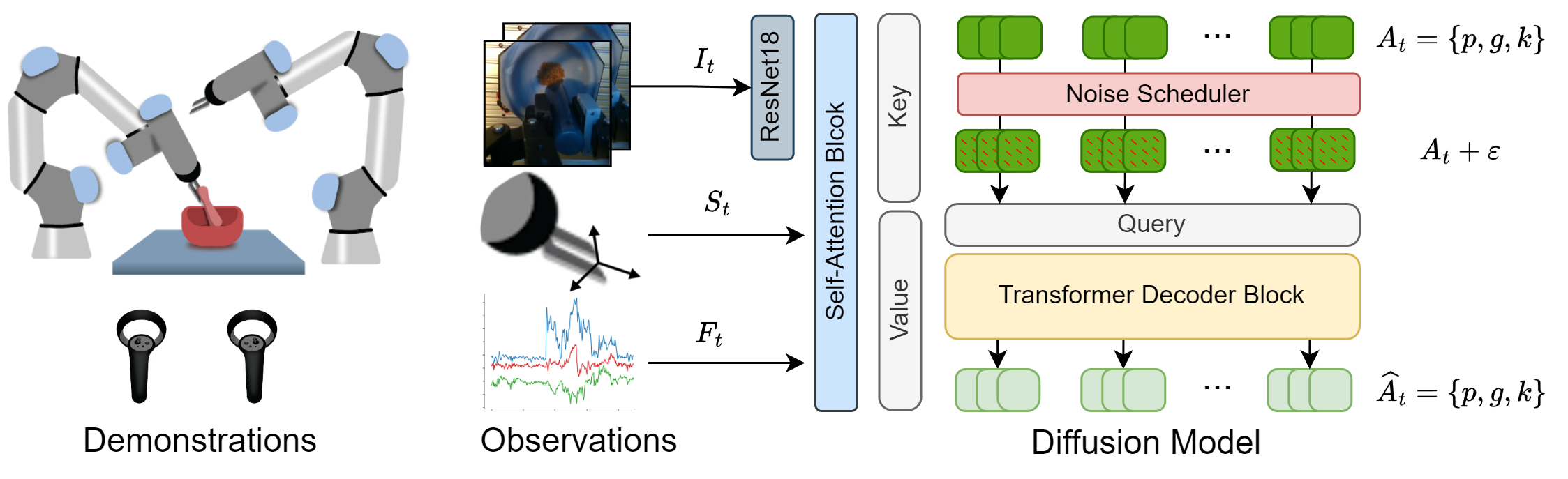
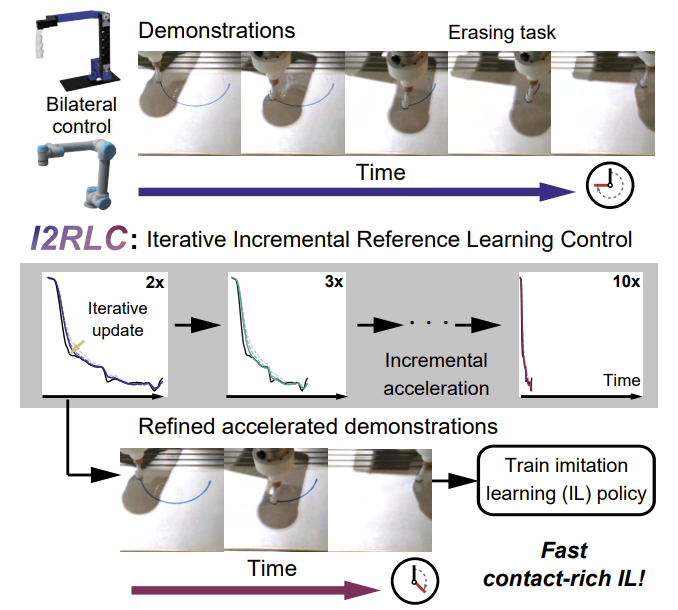
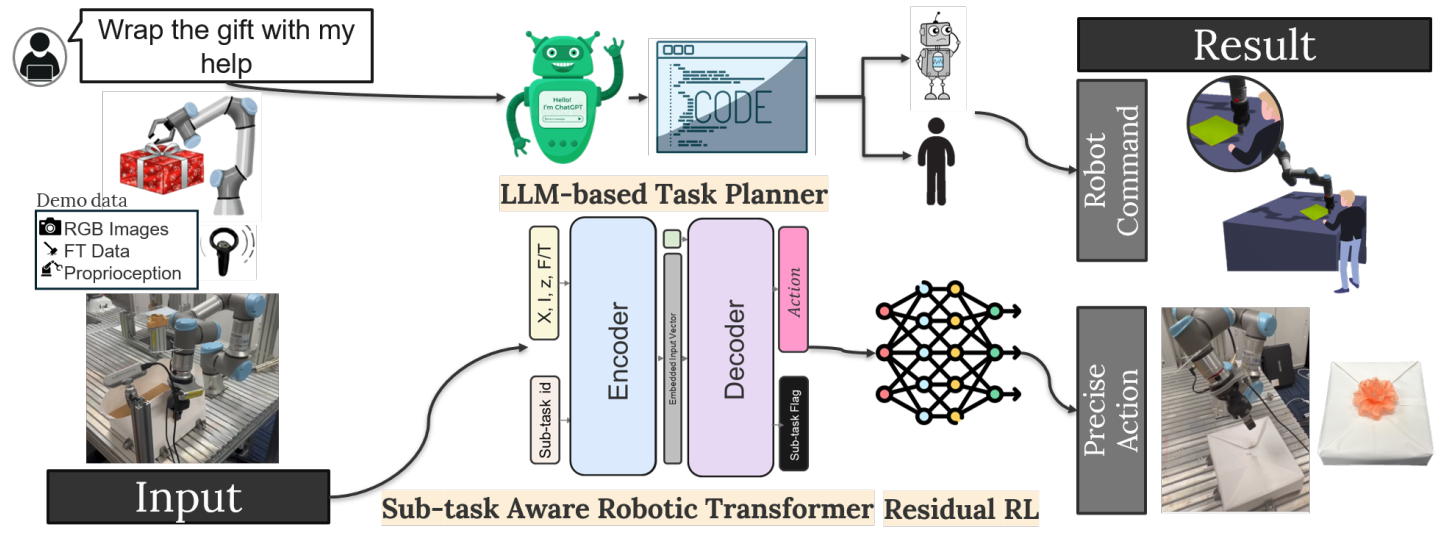
More recent work moves to generative policies: diffusion policies learned from demonstrations for compliant contact-rich manipulation (Beltran-Hernandez et al., 2026), refinement of accelerated demonstrations through incremental iterative reference learning control — trading demonstration speed against tracking accuracy so that fast imitation stays stable (Yamane et al., 2026) — and a unified control policy with residual force control for two robots cooperatively wrapping paper, a deformable-object task where the two arms must agree on tension (Ali et al., 2025).
Where these policies run on rigid, position-controlled hardware, the underlying force regulation comes from active compliance control; where it comes from the mechanism instead, see passive compliance.
@inproceedings{aburub2024learning,title={Learning Diffusion Policies from Demonstrations For Compliant Contact-rich Manipulation},author={Beltran-Hernandez, Cristian C. and Aburub, Malek and Kamijo, Tatsuya and Hamaya, Masashi},year={2026},archiveprefix={arXiv},primaryclass={cs.RO},url={https://arxiv.org/abs/2410.19235},}
@article{yamane2026refinement,title={Refinement of Accelerated Demonstrations via Incremental Iterative Reference Learning Control for Fast Contact-Rich Imitation Learning},author={Yamane, Koki and Beltran-Hernandez, Cristian C. and Oh, Steven and Hamaya, Masashi and Sakaino, Sho},journal={arXiv preprint arXiv:2604.16850},year={2026},}
2025
Under Review
Learning-based Cooperative Robotic Paper Wrapping: A Unified Control Policy with Residual Force Control
@misc{ali2025learning,title={Learning-based Cooperative Robotic Paper Wrapping: A Unified Control Policy with Residual Force Control},author={Ali, Rewida and Beltran-Hernandez, Cristian C and Wan, Weiwei and Harada, Kensuke},primaryclass={cs.RO},year={2025},}
2nd Best Poster - Collecting, Managing, and Utilizing Data through embodied Robots workshop - IROS2024
@inproceedings{kamijo2024learning,author={Beltran-Hernandez, Cristian C. and Kamijo, Tatsuya and Hamaya, Masashi},title={Learning Variable Compliance Control From a Few Demonstrations for Bimanual Robot with Haptic Feedback Teleoperation System},booktitle={IEEE/RSJ International Conference on Intelligent Robots and Systems (IROS)},year={2024},}
@inproceedings{wang2021robotic,author={Wang, Yan and Beltran-Hernandez, Cristian C. and Wan, Weiwei and Harada, Kensuke},booktitle={IEEE International Conference on Robotics and Automation (ICRA)},title={Robotic Imitation of Human Assembly Skills Using Hybrid Trajectory and Force Learning},year={2021},volume={},number={},pages={11278-11284},doi={10.1109/ICRA48506.2021.9561619},}
@article{wang2021hybrid,author={Wang, Yan and Beltran-Hernandez, Cristian C. and Wan, Weiwei and Harada, Kensuke},journal={IEEE Access},title={Hybrid Trajectory and Force Learning of Complex Assembly Tasks: A Combined Learning Framework},year={2021},volume={9},number={},pages={60175-60186},doi={10.1109/ACCESS.2021.3073711},}
@article{wang2022adaptive,title={An Adaptive Imitation Learning Framework for Robotic Complex Contact-Rich Insertion Tasks},author={Wang, Yan and Beltran-Hernandez, Cristian C and Wan, Weiwei and Harada, Kensuke},journal={Frontiers in Robotics and AI},volume={8},pages={777363},year={2021},publisher={Frontiers},doi={10.3389/frobt.2021.777363},}